Carrying More Than Water: The Weight of Patriarchal Expectations
We have all, at least once in our lives, heard or even sung the classic line, “Mai Chori Sundari, kasari bharu pani?” from the song Mai Chori Sundari by Bharati Upadhya. While many recognize the melody, few truly understand the deeper story it conveys. The song reflects the structural dominance of men and the constraints placed upon women within society. Even the title suggests how a woman’s identity is closely tied to her beauty. Beyond portraying the physical struggle of fetching water, the song explores broader themes of societal pressure and expectations from a young woman’s perspective.
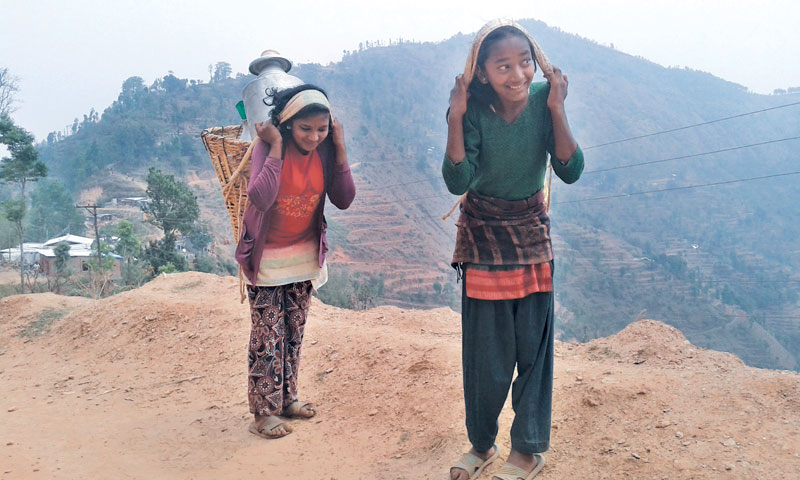
Bharati Upadhya effectively captures the lived reality of countless girls across Nepal: the burden of carrying heavy water vessels, known as gagri or ghalcha, often heavier than the girls themselves, only to return home and consume the same water. Through both its thoughtful lyrics and emotionally resonant composition, the song has spread across the nation, carrying with it depth, meaning, and cultural significance.
This interpretation becomes even stronger when the song is viewed through the lens of water access and gender inequality. The young girl’s struggle is not simply personal; it is deeply structural. In many Nepali households, fetching water has traditionally been seen as the responsibility of women and girls. What appears to be a daily household chore is, in reality, a burden that consumes time, energy, health, and opportunity. As Satyajit Pradhan discusses in his article, “Mai Chori Sundari” (मै छोरी सुन्दरी): Empowering Girls Through Water Access in Nepal, the song reflects how the responsibility of carrying water can affect a girl’s health, education, and dignity.
The line “Mai Chori Sundari, kasari bharu pani?” therefore carries more weight than it first appears to. It is not merely a question about how to fill a water vessel. It is a question about how a young girl is expected to carry responsibilities beyond her age and strength. The water vessel becomes a symbol of the larger weight society places on girls: the weight of domestic labour, silence, obedience, and sacrifice. Her beauty, suggested through the word “Sundari,” does not protect her from hardship. Instead, it reveals the contradiction of a society that praises women for their appearance while ignoring their labour and pain.
The song also reminds us that inequality is often hidden inside ordinary routines. Fetching water, cooking, cleaning, and caring for the household may seem normal because they have been repeated for generations. However, songs like Mai Chori Sundari force us to question this normalcy. Why is the burden placed on girls? Why is their time considered less valuable? Why are their dreams, education, and physical comfort sacrificed for duties that society rarely recognizes as labour?
Even today, the message of the song remains relevant. Although access to water, education, and social awareness has improved in many places, countless girls still face similar expectations. The struggle may not always look the same, but the pattern continues whenever girls are expected to give up their freedom, education, or childhood for household responsibilities. In this way, Mai Chori Sundari becomes timeless. It speaks not only to the past but also to the present.
In conclusion, Mai Chori Sundari is far more than a familiar folk song. It is a cultural text, a social critique, and a quiet call for justice. Bharati Upadhya’s voice gives life to the unspoken experiences of many Nepali girls and women whose labour has long been overlooked. The song teaches us that music can preserve memory, expose inequality, and inspire reflection. Its melody may be soft, but its message is powerful: no girl should have to carry the weight of society alone. Mai Chori Sundari is not just a song about carrying water; it is a song about carrying expectation, inequality, and resilience.
Reference
Pradhan, S. (2024). “Mai Chori Sundari” (मै छोरी सुन्दरी): Empowering Girls Through Water Access in Nepal. LinkedIn.
Thoughts
Leave a thought, disagreement, fragment, reaction, or whatever stayed with you after reading.